Let’s be honest: most “digital identity” systems today are privacy disasters. They ask for way too much data, store it in the wrong places, and then act surprised when it gets leaked.
As digital identity systems evolve, privacy is no longer optional— it’s foundational.
Two concepts are shaping how trust works in modern identity systems:
- Selective Disclosure (SD)
- Zero-Knowledge Proofs (ZKPs)
Both are widely used in verifiable credentials, decentralized identity, and verifiable AI systems. They are often mentioned together — and sometimes confused.
Why Privacy Matters in Digital Identity
Traditional Identity
Forces users to overshare data.
- × Sharing a full ID just to prove age
- × Submitting complete documents for simple verification
- × Storing sensitive data in centralized databases
Modern Digital Identity
Must be privacy-first and verifiable.
- Privacy-first
- Verifiable
- Minimal by design
- Compliant with global data protection laws
This is where Selective Disclosure and Zero-Knowledge Proofs come in.
What Is Selective Disclosure?
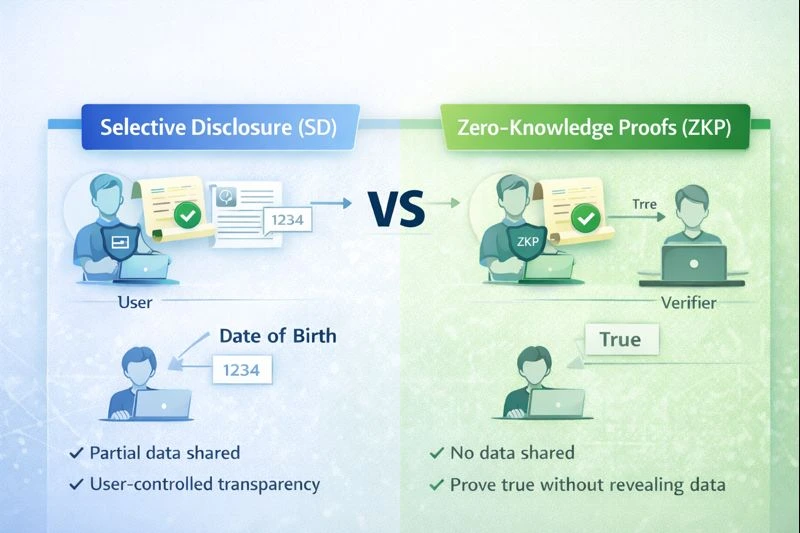
Selective Disclosure (SD) allows a user to share only specific fields from a verifiable credential — instead of the entire credential.
For Example:
From a government ID
Share only date of birth
From a degree certificate
Share only degree name
From an employee credential
Share only company name
The Verifier:
Key benefits of Selective Disclosure
- Simple and efficient
- Easy to implement
- Reduces unnecessary data exposure
- Works well for most business use cases
Selective Disclosure answers:
👉 “Can I reveal just what’s needed — and nothing more?”
What Are Zero-Knowledge Proofs (ZKPs)?
Zero-Knowledge Proofs is a cryptographic method that allow someone to prove a statement is true without revealing the underlying data at all.
Instead of sharing values, users share cryptographic proofs.
Prove you are over 18 without revealing your date of birth
Prove you hold a valid license without revealing the license number
Prove an AI agent is authorized without exposing internal permissions
The verifier learns only the outcome, not the data.
Key benefits of Zero-Knowledge Proofs
- Maximum privacy
- Strong cryptographic guarantees
- Ideal for sensitive or regulated data
- Enables advanced trust models
ZKPs answer a more powerful question:
👉 “Can I prove this is true without revealing anything else?”
Selective Disclosure vs Zero-Knowledge Proofs
When Should You Use Selective Disclosure?
Ideal when:
- Partial data sharing is acceptable
- Performance and simplicity matter
- Users need transparency over what is shared
Common use cases:
- • Educational credential verification
- • Employment verification
- • Event access passes
- • Partner or vendor credentials
- • Cross-platform identity checks
When Are Zero-Knowledge Proofs Necessary?
Critical when:
- Even partial data exposure is risky
- Compliance requirements are strict
- Identity misuse has serious consequences
Common use cases:
- • Age verification
- • KYC and financial compliance
- • Healthcare credentials
- • Government-issued identities
- • AI agent authorization (verifiable AI)
How Verifiable Credentials Tie It All Together
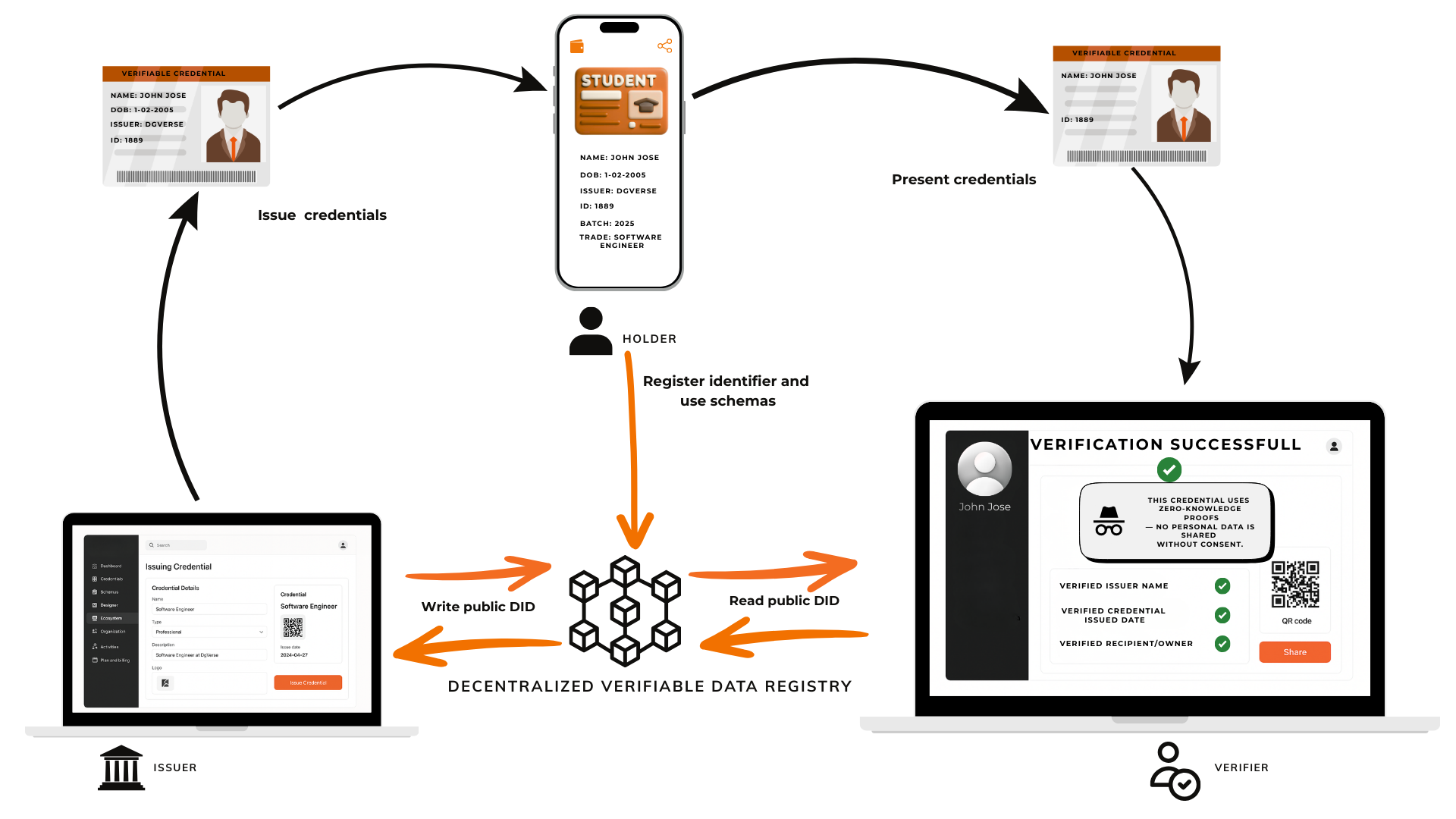
Both Selective Disclosure and Zero-Knowledge Proofs are core capabilities of modern verifiable credentials.
Verifiable credentials provide:
- Cryptographic integrity
- Issuer trust
- Holder control
- Verifier independence
SD and ZKPs define:
How much information is revealed during verification.
Together, they enable:
Privacy-first digital identity, Reduced data storage, Regulatory compliance, User-controlled trust
This creates accountable, auditable, and privacy-preserving AI systems.
Privacy for Verifiable AI and Autonomous Agents
As AI agents operate autonomously, privacy and trust become even more important.
Verifiable AI systems need to:
- Prove identity and authority
- Minimize data leakage
- Prevent over-permissioning
Using:
Selective Disclosure
→ reveal only required permissions
Zero-Knowledge Proofs
→ prove authorization without exposing internal logic
This creates accountable, auditable, and privacy-preserving AI systems.
The Future of Digital Identity Is Minimal Disclosure
The future of digital identity is not about sharing more data — it’s about sharing less, but with more trust.
Selective Disclosure and Zero-Knowledge Proofs are no longer advanced concepts — they are essential infrastructure.
Why DgVerse
DgVerse enables organizations to issue and verify privacy-first verifiable credentials with built-in support for:
Whether you’re building digital identity platforms, compliance systems, or verifiable AI solutions, DgVerse helps you build trust without overexposing data.
👉 Because the strongest trust reveals the least.
Talk to us about building Privacy-First Systems